
SCREEN ADDICTION
Updated: May 7

THE BRIEF: Global statistics and research regarding social media, gaming and multimedia devices on a young person's mindset, social skills, education, cerebral development and behaviour. Is it the new drug addiction behaviour for the younger generation?
AI EXPLANATION: This is a serious and well-studied question—and the honest answer is: there are real parallels to addiction, but it’s not as simple as “screens = drugs.” The effects depend heavily on the type of use, duration, content, and the child’s environment.
Below is a grounded, research-based breakdown across the areas you asked about.

1. GLOBAL USAGE PATTERNS
(what kids are actually doing)
Children aged 9–11 average several hours per day on digital media (video, gaming, social media combined).
Large longitudinal studies (4,000+ kids) show:
~40–50% display high or escalating “addictive-style” usage patterns (phones/games).
In Australia specifically:
~2–3% meet criteria for gaming disorder
~10% show smartphone addiction symptoms
👉 So this is not fringe—it’s widespread and growing.
2. BRAIN DEVELOPMENT (cerebral structure & function)
A child's brain is considered fully developed in the mid-to-late 20s, generally around age 25. While the brain reaches about 90% of its adult size by age 5, the prefrontal cortex—the area responsible for planning, impulse control, and decision-making—is the last to mature, continuing to develop through adolescence.
Key Stages of Brain Development:
Birth to Age 5: Massive growth; the brain reaches 80% of adult size by age 3 and 90% by age 5.
Adolescence (10–24 years): Intense remodelling and fine-tuning occur, driven by experience and hormonal changes.
Mid-to-Late 20s (approx. 25): The frontal lobes fully develop, completing the maturation process.
Although structural development largely stops around 25, the brain retains the ability to adapt and change throughout life.
SO A CHILD'S BRAIN IS STILL DEVELOPING UNTIL 25 !!!

What research actually shows (important nuance)
A major 2024 MRI study (4,500+ children):
No major overall change in cortex development from general screen use
BUT:
Subtle changes in the striatum (reward system) in some groups
A broader review:
Digital addiction is linked to changes in brain structure and function, especially in:
reward circuits
attention networks
impulse control systems
Other studies:
Altered brain chemistry and connectivity in addicted youth
Impacts areas for decision-making, memory, and emotional regulation
👉 Translation: Not “brain damage” in a simplistic sense—but measurable rewiring in systems tied to reward, attention, and control.
3. DOPAMINE and “addiction-like” behaviour

This is where the “new drug” comparison comes from.
Social media and games trigger dopamine release loops (reward anticipation → hit → craving)
Design features amplify this:
infinite scroll
notifications
unpredictable rewards (likes, wins, loot boxes)
These mimic variable reward schedules, the same mechanism used in:
gambling machines
addictive substances (indirectly via dopamine pathways)
Evidence:
Brain scans show patterns similar to behavioural addictions
Researchers explicitly describe “internet addiction” altering brain chemistry
👉 Key distinction:
It’s behavioural addiction, not chemical ingestion
But the neural pathways overlap
4. COGNITIVE EFFECTS (attention, learning, education)

Strong evidence here:
Gaming addiction is linked to:
reduced attention
impaired memory
lower learning performance
Large-scale cognitive studies:
Heavy social media use → lower reading, memory, and vocabulary scores
General findings across 100+ studies:
Higher screen time correlates with:
anxiety
lower academic performance
behavioural problems
👉 Mechanism:
Constant stimulation → reduced ability to sustain focus
Multitasking → shallow processing instead of deep learning
5. SOCIAL SKILLS & BEHAVIOUR
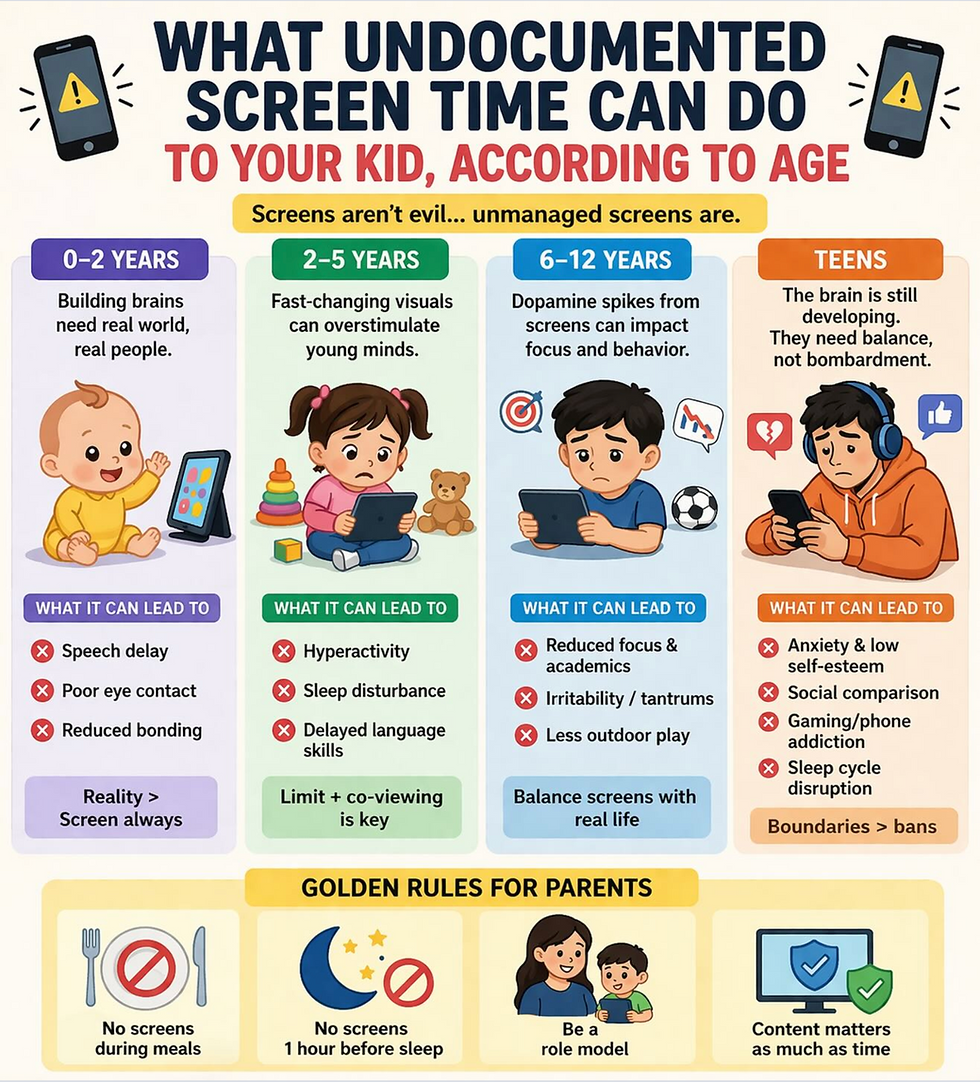
Consistent trends across research:
Negative associations
Reduced face-to-face interaction → weaker:
empathy
conversational ability
Increased:
irritability
aggression (in some cases)
emotional dysregulation
Concerning behavioural patterns
Avoiding real-world activities
Sleep disruption
Emotional dependency on devices
Extreme cases (documented clinically):
Withdrawal symptoms when devices removed
Loss of interest in real-world relationships
6. MENTAL HEALTH RISKS

Some of the strongest evidence:
High addictive use → 2–3× higher risk of suicidal thoughts/behaviour
Links to:
anxiety
depression
low self-esteem
body image issues
👉 Important nuance:
Risk is tied more to addictive patterns and content, not just total screen time.
7. NEW DRUG ADDICTION?

Where the comparison is accurate?
✔ Same brain systems involved (dopamine, reward, habit loops)
✔ Compulsive use despite harm
✔ Withdrawal-like symptoms
✔ Tolerance (needing more stimulation)
Where it differs?
✖ No external chemical ingestion
✖ Effects are more behaviourally conditioned
✖ Can be beneficial in moderation (learning, social connection, skills)
👉 Best scientific framing:
“Behavioural addiction with neurobiological overlap to substance addiction.”
8. WHAT ACTUALLY MATTERS MOST (this is crucial)

Research is very clear on this:
It’s NOT just screen time—it’s:
1. Type of content
Passive scrolling → worst outcomes
Educational / creative use → neutral or positive
2. Pattern of use
Compulsive, uncontrollable = risk
Structured, limited = manageable
3. Displacement effect
What is being replaced?
Sleep? (major issue)
Physical activity?
Real relationships?
4. Age vulnerability
Ages 9–14 are especially sensitive due to:
brain plasticity
identity formation
reward system development
Bottom line
Yes—there is real scientific evidence that:
digital media can shape brain systems
addictive patterns exist
behaviour can resemble addiction
But:
It is not inherently harmful in all cases
The danger is in unregulated, high-reward, compulsive use
A GROUNDED CONCLUSION

If you strip away hype and fear:
👉 Digital media is not “the new drug” in a literal sense
👉 But certain forms of it are engineered to behave like one
And for an 11-year-old:
Their brain is still wiring reward, focus, and identity
So exposure + lack of boundaries = real developmental risk
Here are research-grounded, practical limits for an 11-year-old, aligned with bodies like the World Health Organization and American Academy of Pediatrics) :

1. DAILY SCREEN TIME LIMITS (the baseline)
✅ Recommended range (age 10–12)
≤ 2 hours/day recreational screen time
Schoolwork does not count toward this!
Why this number exists?
Consistently across studies, >2–3 hours/day is where risks rise:
anxiety & depression
sleep disruption
lower academic performance
Under ~2 hours:
outcomes are generally neutral to mildly positive
👉 This is the single most evidence-supported threshold.
2. DAILY STRUCTURE (more important than raw hours)
Research shows when and how screens are used matters more than totals.
A healthy daily pattern:
❌ No screens before school
Improves attention, mood, and learning readiness
❌ No screens 60–90 minutes before bed
Protects melatonin and sleep quality
✅ Screens after responsibilities
Homework, chores, physical activity first
✅ Break every 30–45 minutes
Reduces attention fatigue and overstimulation
3. WEEKLY LIMITS (this is often ignored—but critical)
Even if daily use looks fine, weekly accumulation predicts risk.
Healthy weekly pattern:
≤ 14 hours/week recreational total
At least:
1–2 screen-free days OR half-days
👉 Why:
Studies show cumulative exposure affects:
attention span
emotional regulation
dependency patterns
4. GAMING SPECIFIC LIMITS (higher risk category)
Gaming has stronger links to addiction-like behaviour than general screen use.
Evidence-based limits:
Weekdays: 0–60 minutes
Weekends: 1–2 hours max
Non-negotiables:
❌ No “just one more game” extensions
❌ No late-night gaming
❌ No online multiplayer without supervision (at this age)
👉 Why stricter?
Variable reward systems (wins, loot, ranking) → stronger dopamine loops
5. SOCIAL MEDIA (most sensitive category)
For 11-year-olds, research leans cautious.
Recommended:
Ideally: delay full access
If allowed:
≤ 30–60 minutes/day
Supervised or shared-account use
👉 Why:
Strongest links to:
anxiety
self-esteem issues
addictive scrolling patterns
6. SLEEP PROTECTION (non-negotiable rule)
Sleep disruption is the most consistently proven harm.
Hard boundary:
All devices off 1–2 hours before bed
No devices in bedroom overnight
👉 Evidence shows:
Even passive screen exposure reduces:
sleep duration
sleep quality
next-day cognitive performance
7. REPLACEMENT RULE (this protects development)
Research shows harm comes largely from what screens replace.
Daily minimums that must stay intact:
9–11 hours sleep
60+ minutes physical activity
Face-to-face interaction (family or peers)
Offline play / creativity
👉 If screens push these out → problems begin
8. CONTENT QUALITY FILTER (often more important than time)
Low-risk use:
Educational videos
Skill-based games
Creative tools (drawing, building, music)
High-risk use:
Infinite scrolling feeds
Fast-cut, high-stimulation videos
Competitive online gaming loops
👉 Same time, different outcome.
9. BEHAVIOURAL RED FLAGS (when limits need tightening)
Research-backed warning signs:
Irritability when screens are removed
Sneaking or lying about usage
Loss of interest in normal activities
Sleep disruption
Decline in school performance
👉 If you see these:
Reduce access immediately
Add structure—not just punishment
10. SIMPLEST EVIDENCE-BASED FRAMEWORK
If you want something easy to apply, this works:
The “2–1–0 rule”
2 hours max recreational screen time
1 hour off before bed
0 screens in bedroom overnight
Backed by sleep, behavioural, and developmental research.
BOTTOM LINE:
The safest, research-supported zone for an 11-year-old is:
Moderate, structured, supervised use
The danger zone is:
Unrestricted, high-reward, late-night, or compulsive use.
👉 It’s not about banning screens
👉 It’s about preventing the brain from wiring itself around them.

THE BRIEF: Global statistics and research regarding extended screen exposure in young adults and teenagers' cerebral development and social behaviour, and a brain comparison to masturbation and other instant gratification. It is all doing the same thing as far as brain development and behaviour in it's addiction?
AI EXPLANATION: Yes — there is substantial neuroscience research showing that excessive screen exposure, compulsive social media use, gaming, pornography, masturbation tied to compulsive stimulation, and other instant-gratification behaviours can affect many of the same brain reward systems.
But it is important to be accurate:
They are not identical addictions, but they can operate through overlapping dopamine/reward circuitry and similar behavioural conditioning mechanisms.
That distinction matters scientifically. The core issue: the brain’s reward system!

The main system involved is the dopamine reward pathway:
ventral tegmental area
nucleus accumbens
ventral striatum
prefrontal cortex

These systems regulate:
motivation
reward-seeking
attention
impulse control
habit formation
Research shows adolescence and young adulthood are especially vulnerable because:
dopamine systems are highly active
impulse control systems are still developing
neuroplasticity is very high.
Extended Screen Exposure & the Adolescent Brain?

Research on internet addiction and compulsive screen use has found:
impaired impulse-control networks
altered frontal-basal ganglia connectivity
increased reward sensitivity
reduced executive control

One study on adolescents with internet addiction found measurable disruption in brain connectivity involved in:
decision-making
self-control
behavioural regulation
This is why compulsive scrolling/gaming can feel:
difficult to stop
mentally “sticky”
emotionally compulsive
Why Social Media & Scrolling become Addictive?

Social media platforms use what psychologists call:
“variable reward schedules”
This means:
you do not know when the next rewarding thing will appear
likes, messages, videos, novelty arrive unpredictably
That unpredictability strongly activates dopamine anticipation systems — similar to gambling mechanisms.
The dopamine spike is often strongest in:
anticipation
novelty
unpredictability
Not necessarily pleasure itself.
That is why people keep refreshing feeds compulsively.
Pornography, Masturbation & Instant Gratification
This area is more controversial publicly, but there is legitimate neuroscience research showing overlap with addiction pathways.

Studies have found:
ventral striatum activation
reward-circuit sensitization
cue-reactivity patterns resembling substance addictions
Research reviews now classify problematic pornography use as a potential:
Behavioural Addiction involving Reward, Motivation, and Memory Circuitry

Some neuro-imaging studies found pornography cues produced:
stronger reward responses than gaming
high anticipatory dopamine activation
Are screens, porn, masturbation, gaming, junk food, etc. “the same”?

Scientifically:
No — but they can train the brain similarly.
They all can involve:
dopamine-driven reward learning
instant gratification
compulsive repetition
reduced tolerance for delayed rewards
habit-loop reinforcement

This is why neuroscientists often group them under:
“Behavioural Addictions”
So the biggest concern is not merely pleasure.
It is:
Conditioning the Brain toward Constant High Stimulation

When the brain becomes accustomed to:
rapid novelty
instant rewards
constant stimulation
then slower real-world rewards can begin to feel:
boring
emotionally flat
difficult to sustain attention toward

Research and clinicians report associations with:
reduced attention span
emotional dysregulation
lower frustration tolerance
reduced motivation
social withdrawal
anxiety/depression patterns

Social Development Effects
Extended screen exposure in teens is associated with:
less face-to-face interaction
weaker conversational skills
increased loneliness despite “connection”
emotional dependency on digital validation
This does not happen to everyone equally, but trends are consistent in large studies.

A Major Issue is:
replacement behaviour
Screens replace:
real friendships
boredom tolerance
outdoor activity
emotional resilience
long-form thinking
The Prefrontal Cortex Problem

The prefrontal cortex handles:
self-control
planning
delayed gratification
emotional regulation
It is still developing into the mid-20s.
At the same time:
adolescent dopamine systems are hypersensitive to rewards
This creates a perfect storm:
high reward drive
weak impulse control
That is why teens are particularly vulnerable to compulsive behaviours.
Important Nuance: Masturbation itself is not automatically “Brain Damage”
Research does not support the claim that occasional masturbation itself inherently destroys the brain.

The concern arises when there is:
compulsive use
pornography dependency
escalation
isolation
emotional dependency
reward-system conditioning
That distinction matters.
A Useful Comparison
Think of the reward system like this:
Healthy Reward | Hyperstimulating Reward |
conversation | endless scrolling |
exercise | compulsive gaming |
relationship bonding | compulsive porn use |
learning a skill | rapid novelty feeds |

The hyper-stimulating rewards produce:
faster
easier
more frequent dopamine spikes
The brain can begin preferring them over effort-based rewards.
The Strongest Scientific Conclusion -
The best-supported conclusion from current neuroscience is:
Excessive exposure to hyper-stimulating instant-gratification behaviours can condition adolescent reward systems in ways that resemble behavioural addiction patterns.

That includes:
social media
gaming
compulsive pornography use
endless scrolling
other high-dopamine digital habits
But there is also HOPE: Neuro-Plasticity works both ways!
The adolescent brain is highly plastic.
That means harmful patterns can form more easily —but healthier pathways can also be rebuilt.

Research shows improvement with:
reduced compulsive exposure
exercise
sleep restoration
delayed gratification habits
real-world social interaction
meaningful goals
boredom tolerance training
The Balanced Conclusion
The evidence does not support saying:
“all screens are drugs”
But the evidence does support saying:
Many modern digital systems are engineered to exploit the same reward-learning mechanisms involved in behavioural addiction!

And in developing brains, excessive exposure can meaningfully shape:
attention
motivation
emotional regulation
social development
impulse control
especially when use becomes compulsive or replaces real-world growth.

_____
🧠 Year 6 Lesson: “Are Screens Controlling Me?”
Time: 60 minutes
Subject Links (QLD KLA):
Health & Physical Education (wellbeing, decision-making)
Digital Technologies (impact of tech on behaviour)
English (reflection, reasoning)
👇 STUDENT WORK PACK
✏️ PART 1 — Quick Start (5 mins)
Circle your answer honestly:
I use screens every day
YES / NO
I feel annoyed when I have to stop
YES / NO
I use screens before bed
YES / NO
I sometimes lose track of time
YES / NO
👉 If you said YES to 2 or more → your brain might be getting “hooked”
🧠 PART 2 — What’s Going On in My Brain? (10 mins)
Read this:
When you:
win a game
get likes
watch exciting videos
Your brain releases a chemical called dopamine.
👉 Dopamine makes you feel good…BUT it also makes you want to keep going again and again
✏️ Question:
Why do games and apps try to keep you playing?
Write your answer:
✔️ Expected idea:
They want you to stay longer
They give rewards, points, likes
They don’t have an “end”
_______________________________________________
_______________________________________________
_______________________________________________
🔍 PART 3 — Spot the Problem (10 mins)
Are these habits healthy or unhealthy?
Write:
✅ Healthy
⚠️ Risky
❌ Unhealthy
Gaming for 4 hours straight ___
Watching a tutorial to learn drawing ___
Using your phone in bed ___
Playing outside with friends ___
Scrolling when bored ___
Gaming after homework for 1 hour ___
⏱ PART 4 — The Real Rules (5 mins)
The 2–1–0 Rule
2 hours max fun screen time
1 hour off before bed
0 screens in bedroom at night
✏️ Question:
Which one would be hardest for you? Why?
_______________________________________________
_______________________________________________
_______________________________________________
📊 PART 5 — Your Real Screen Use (10 mins)
Fill this in:
Yesterday I spent:
Gaming: ______ hours
Videos/YouTube: ______ hours
Other: ______ hours
👉 TOTAL: ______ hours
✏️ Question:
Is this above or below 2 hours?
✏️ Reflection:
How do you feel after lots of screen time?
(circle any)
tired
happy
bored
grumpy
fine
distracted
🛠 PART 6 — Build Your Own Plan (15 mins)
🎯 Your Goal: Take control of your screen use
Fill this in:
1. My daily limit will be: ☐ 1 hour ☐ 2 hours ☐ Other: ______
2. I will NOT use screens at this time:
3. One habit I will STOP:
4. One healthy thing I will DO instead:☐ sport☐ reading☐ building☐ drawing☐ other: ______
5. My rule for bedtime: _______________________________________________
🧠 PART 7 — Final Thinking (5 mins)
Write 3 sentences:
1. Screens can affect my brain by _______________________________________
2. Too much screen time can ___________________________________________
3. I will control my screen use by _______________________________________
👨🏫 PARENT / TEACHER GUIDE (quick)
What this lesson achieves:
Builds self-awareness (not shame)
Teaches dopamine + behaviour loops
Applies real research limits (2–1–0 rule)
Ends with personal action plan
🔑 MOST IMPORTANT TAKEAWAY FOR THE CHILD
Say this clearly at the end:
“Screens aren’t bad.But some are designed to control your brain. You’re learning how to stay in control.”
🚀 Optional Extension
For the next 3 days:
Track screen time
Follow their plan
Then ask:
What changed?
Was it hard?
What worked?

Comments