
LEVITICUS: Royal Priestly Behaviour

The Complete Guide to Understanding How Ancient Priesthood Patterns TRANSFORM Through Yahusha's New Covenant Order of Melchizedek!
INTRODUCTION:
The Training Manual for Dwelling with Divine Presence!
Most readers approach Leviticus with hesitation. The book speaks of blood, sacrifices, skin diseases, dietary restrictions, and ceremonial regulations that can seem foreign, harsh, or even obsolete in a modern context. Yet Leviticus is not a collection of random religious rules. It is a sophisticated training manual designed to answer one fundamental question: How can a perfectly set-apart Alahim dwell among imperfect people without annihilating them?
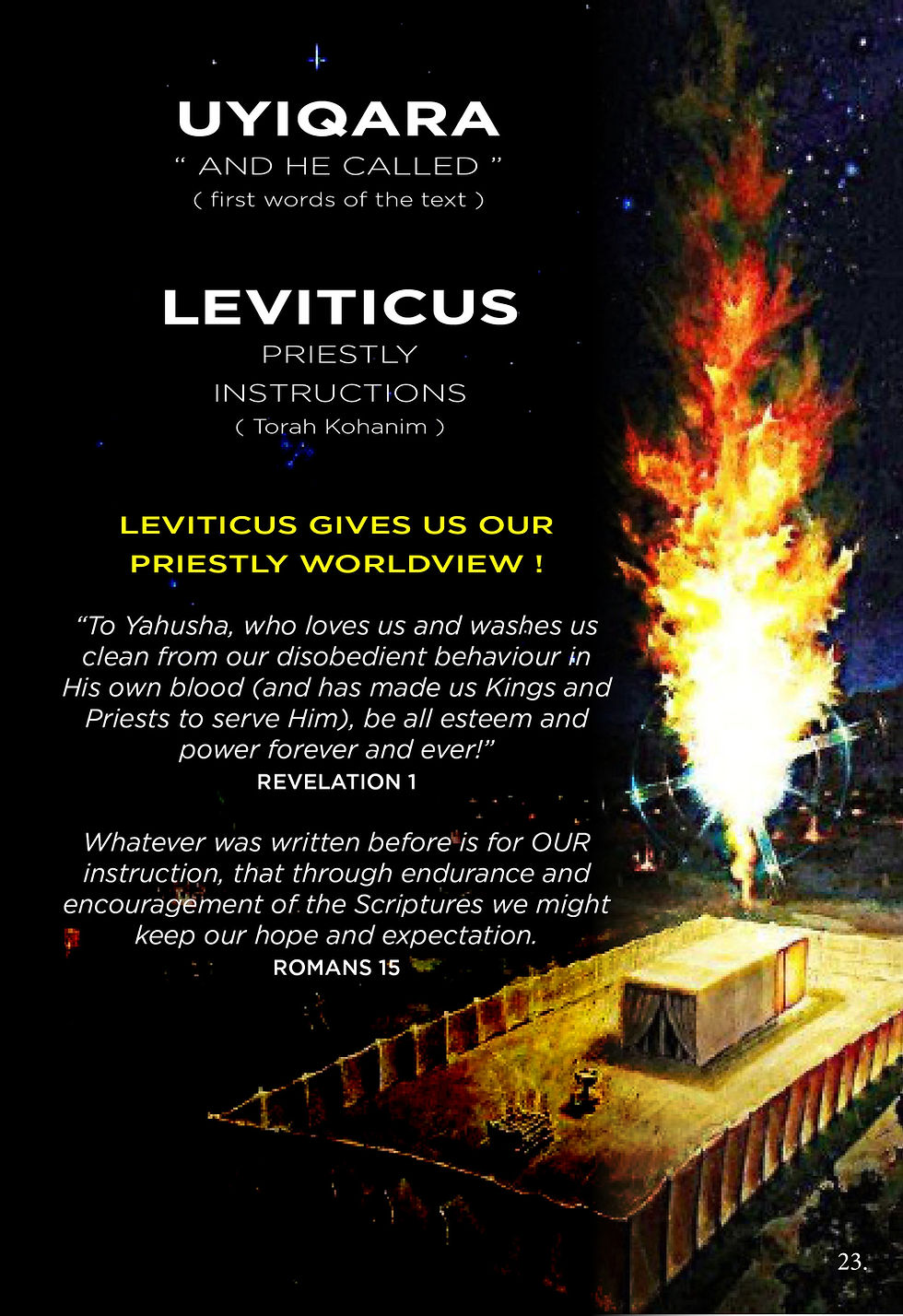
Leviticus continues directly from Exodus, with Israel still camped at Mount Sinai. The Blood-Covenant has once again been established, this time through Moses; the Tabernacle has been constructed; the Priesthood has been appointed; and Yahuah has descended in fire. Deliverance from Egypt was never the ultimate goal - Alahim dwelling among them was! The entire purpose of Israel's Exodus was to fulfil the Covenant Promise given to Abram: to bring His chosen people into the Marriage Covenant and the promised Marriage Home of Canaan.
Now that the physical dwelling place for Yahuah's presence has been prepared, a new and urgent question emerges. How does sinful humanity live in proximity to consuming fire without being destroyed? Leviticus provides the answer through substitution, blood, purification, instruction, and behaviour.
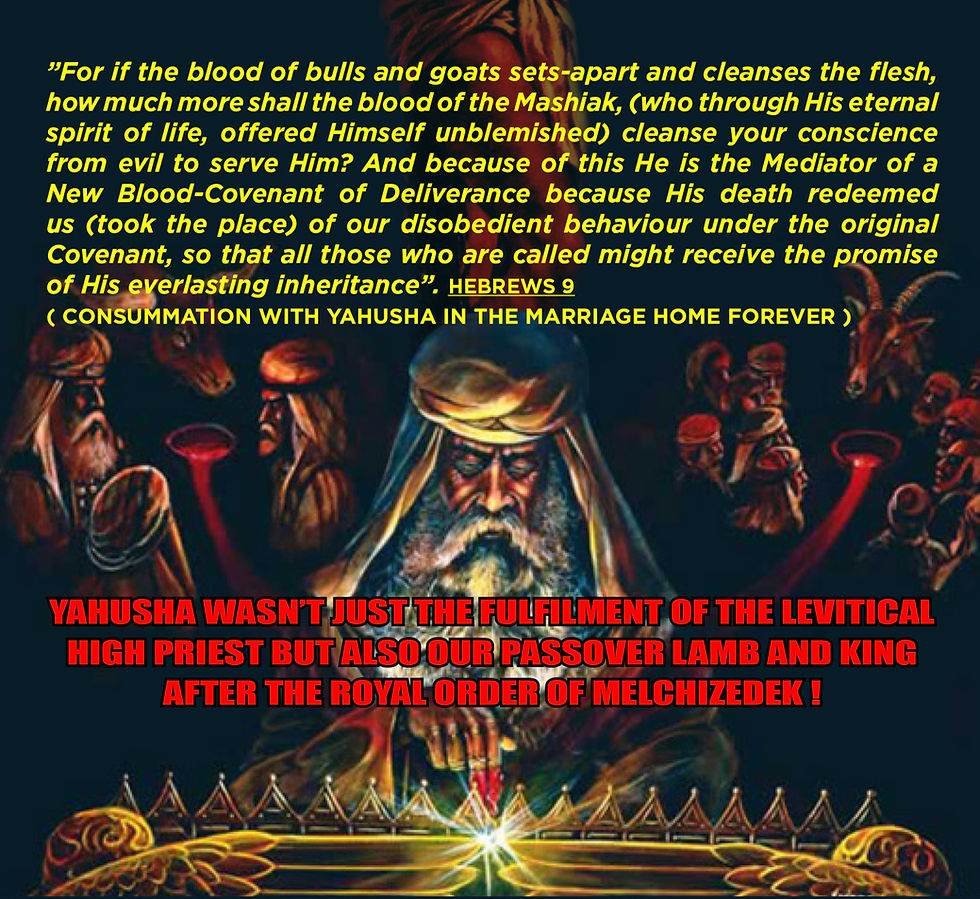
In Yahusha's New Blood-Covenant however, the outward shadows of Levitical practice transform into inward spiritual realities, yet the underlying requirements remain unchanged. Blood must still be shed for an intimate relationship to occur. Purity must still precede presence. Set-apartness must still be guarded. Obedience still matters. However, the Tabernacle is no longer a tent, but our body!
The Priesthood is no longer Levitical - it is the Melchizedek Bride. And the sacrifice is no longer animal blood - it is Yahusha's Eternal, once-for-all offering. Everything in Leviticus points forward to Him, and then forward again to us, who pick up our Torture Stakes to follow Him to the death of our fleshly self on the daily offering of our heart-behaviour (thought by thought).
PART 1:
The Pattern of Approach!
Five Sacrifices for Behavioural Acceptance
Leviticus opens with five distinct offerings, and understanding why the book begins here is crucial. Israel now possessed a dwelling place for Yahuah Alahim, but they lacked understanding of how to approach Him safely. The Sacrificial System taught structured access, repentance, gratitude, restoration, and intimate fellowship. These offerings were not random rituals but BEHAVIOURAL PATHWAYS that reveal the five essential movements between mankind and Alahim.

1. The Ascending-Near Offering, often called the Burnt Offering, represents total surrender. The entire animal was consumed on the altar, with nothing retained. This foreshadowed Yahusha's complete self-giving, as Paul writes in Ephesians 5:2: "Messiah loved us and gave Himself up for us, a fragrant offering and sacrifice to Alahim."
For His Bride, this becomes daily surrender—the presentation of our bodies as
"living sacrifices" (Romans 12:1).
ROYAL PRIESTLY BEHAVIOUR BEGINS HERE, NOT WITH PARTIAL OBEDIENCE, BUT WITH COMPLETE ABANDONMENT TO YAHUSHA'S WILL.

2. The Grain Offering contained no blood. It consisted of fine flour, oil, and frankincense—representing devoted labour offered in love. This offering taught gratitude and transformed thinking. John 12:24 applies this principle to Yahusha: "Unless a grain of wheat falls into the earth and dies, it remains alone; but if it dies, it bears much fruit." The Bride's mind must be refined by the Word, and service must be performed without self-glory. Gratitude becomes a lifestyle rather than ritual.
3. The Intimate-Peace Offering was unique because it was shared. Part was burnt on the Altar, and part was eaten in a Covenant Meal. Colossians 1:20 reveals its fulfilment: "Through Him to reconcile all things to Himself, making peace by the blood of His Torture Stake."
ROYAL PRIESTLY BEHAVIOUR MANIFESTS AS RESTORED INTIMACY AND RELATIONAL WHOLENESS—LIVING RECONCILED WITH BOTH ALAHIM AND OTHERS.

4. The Purifying Offering addressed ritual contamination from unintentional crimes/sins. Blood was applied specifically for cleansing. Hebrews 9:14 explains how Yahusha fulfils this: "How much more will the blood of the Messiah, who through the eternal Spirit offered Himself without blemih to Alahim, purify our conscience from dead works to serve the living Alahim?" Purification now begins internally, thought by thought, with immediate repentance whenever conscience convicts.
5. The Guilt Offering dealt with specific debt and required not only repentance but restitution. Ephesians 1:7 declares that in Yahusha "we have redemption through His blood, the forgiveness of our trespasses, according to the riches of His favour."
The debt has been paid in full, yet His Bride must live in the integrity of obedient behaviour and make wrongs right wherever possible.
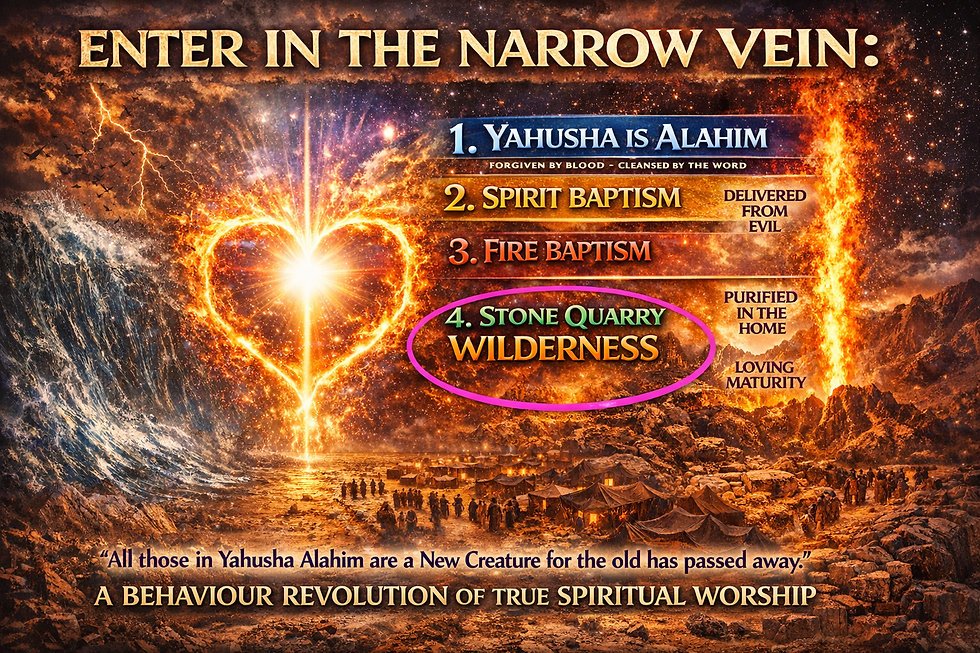
Together, these five sacrifices reveal a continuous behavioural pattern: Surrender leads to Refinement, which enables intimate Fellowship, which requires Purification, which results in Restoration. This is the DELIVERANCE VEIN lived out daily in Yahusha's Bride, demonstrating that relationship with Alahim demands total surrender, purity, intimacy and cleansing - all now fulfilled internally through Yahusha.

PART 2:
Fire Must NEVER Go Out!
Leviticus 6:13 contains a critical command: "The fire on the altar shall be kept burning; it shall not go out." This fire represented Yahuah's ongoing presence among Israel. If the fire went out, access stopped.
Paul echoes this principle in
1 Thessalonians 5:19:
"Do not quench the Spirit."
The altar fire that once burned externally now burns internally within those who belong to Yahusha. To quench this fire is to entertain bitterness, unforgiveness, sexual immorality, pride, or falsehood. The fire is His shared-essence, His incorruptible indwelling presence, and it must remain lit through obedient, sensitive living.
ROYAL PRIESTLY BEHAVIOUR MEANS GUARDING THE INNER ALTAR, RECOGNISING THAT THE SAME FIRE WHICH BLESSES ALSO JUDGES, AND THAT PROXIMITY INCREASES ACCOUNTABILITY.
PART 3:

Strange Fire
(THE DANGER OF CASUAL WORSHIP!)
Leviticus 10 records one of the most sobering events in Scripture: the death of Nadab and Abihu, newly ordained priests who offered incense "which He had not commanded." Fire consumed them instantly. This passage teaches that proximity to Alahim's perfect divinity increases accountability, and the closer one stands to Yahusha, the higher the standard of obedience! The issue was not incense chemistry but obedience. Leviticus teaches that set-apartness is not negotiable. This is not cruelty but the protection of His nature. Ananias and Sapphira demonstrate that this principle did not change in the New Covenant either. The same fire that blesses and purifies also judges and destroys - our behaviour in Yahusha's presence matters!
PART 4:
Food Laws
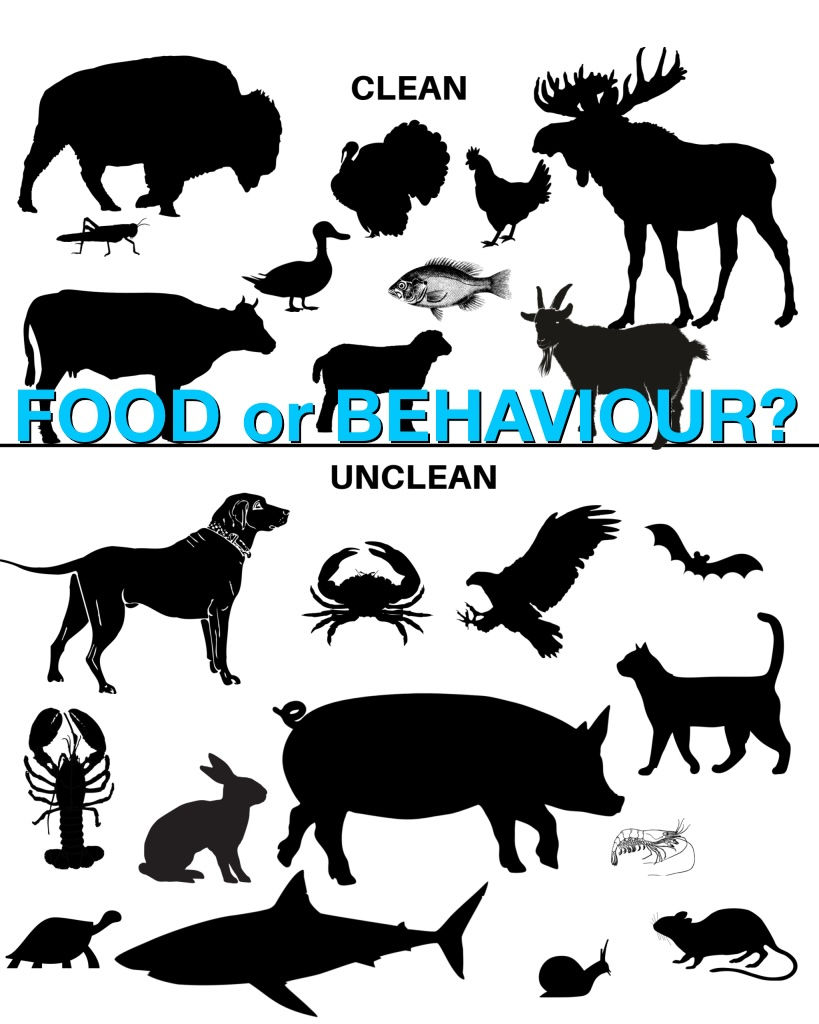
Dietary distinctions in Leviticus did not originate at Sinai. Noah already distinguished clean animals in the Ark. These laws served a specific purpose: marking Israel's identity and separating them from pagan practices. The shadow taught separation, but the fulfilment is all about the inward separation of thoughts and obedience to Yahusha.
Under the New Covenant, no fleshly food grants anyone righteousness. As Paul writes in 1 Cor 8:8 "Food will not commend us to Alahim. We are no worse off if we do not eat, and no better off if we do."
The real contamination is not what enters the mouth but what proceeds from the heart: hatred, envy, malice, pride, and all forms of corruption that defile from within. Purity now is internal, thought by thought from the heart-thinking to behavioural application, walking on Yahusha's Word!
PART 5:

Sexual Behaviour
COVENANT FAITHFULNESS
Leviticus 18–20 defines sexual behaviour clearly because cultures did not agree on morality (what's right and wrong). Before this revelation, nations decided sexual ethics by custom. Yahuah Alahim defined it by design. Israel was entering a land saturated with pagan temple practices, prostitution, and pagan fertility rituals. The boundaries Yahuah gave His people protected their covenant identity as His once Royal Chosen Nation.
The marriage pattern established in Genesis was clear: one male and one female becoming one flesh (Matthew 19:4–6). Marriage is a Covenant, and SEX IS COVENANTAL! Adultery, exploitation, child sacrifice, and pagan temple practices were forbidden because they distorted the created order and fractured family inheritance lines.

In the New Covenant, the standard does not lower; it deepens. Adultery now includes the heart. Lust is inward. Marriage mirrors Yahusha and His Bride. Sexual Purity reflects Covenant Loyalty. The Bride must reflect this committed obedience ...
UNDERSTANDING THAT SEXUAL BEHAVIOUR IS NEVER MERELY PHYSICAL BUT ALWAYS SPIRITUAL, COVENANTAL, AND CONSEQUENTIAL !!
PART 6:
The Evil Tongue
"LASHON HARA"
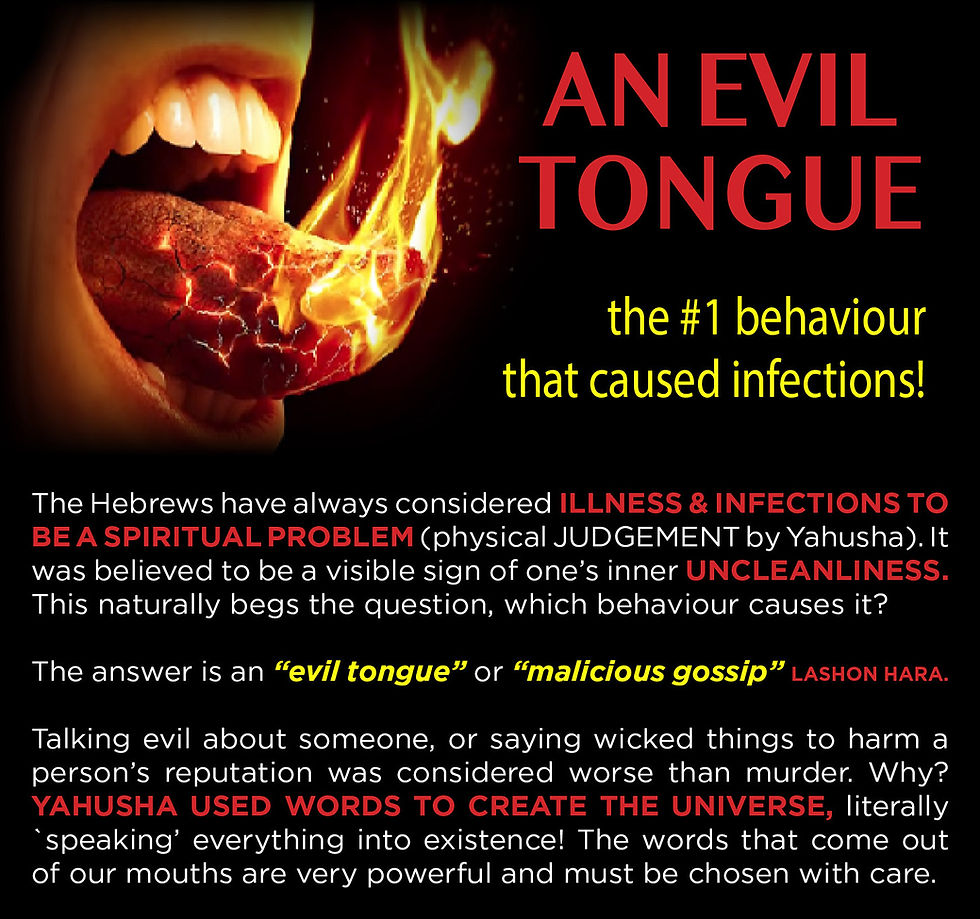
Leviticus devotes considerable space to skin conditions and their diagnosis. The lesson was profound: what proceeds from the mouth reveals inner corruption. Skin disease symbolised visible corruption that required isolation and examination. Scripture consistently teaches about the power of words. James calls the tongue "a fire" that can set the entire course of life ablaze (James 3:6). Words create or destroy. Gossip defiles the community.
ROYAL PRIESTLY BEHAVIOUR GUARDS THE TONGUE, RECOGNISING THAT SPEECH IS NOT NEUTRAL BUT CARRIES CREATIVE OR DESTRUCTIVE POWER (LIFE OR DEATH IS IN THE POWER OF THE TONGUE!)

PART 7:
Servant-Priests
Levitical Priests were not celebrities or spiritual elites. They existed to serve the people - assisting with sacrifices, examining cases, teaching instruction, and guarding spiritual set-apartness. They washed, carried, examined, and served humbly. The Priesthood was established for service, not enrichment. Yahusha embodied this servant-priesthood when He washed His Disciples' feet. Greatness equals servanthood. Under the New Covenant, the "Royal Priesthood" does not mean prestige but humble service, not spiritual dominance or the ego of knowledge!

PART 8:
Tending to the Portal
DIMENSIONAL GATEWAY!
The Tabernacle was a portal—a gateway between dimensions. Without glory, it was only fabric and gold, a mere physical structure. The people waited in anticipation for His glory to fill it. Today, the body is the temple (1 Corinthians 6:19). Yahusha is the Door (John 10:9). The veil of His flesh opened access.

No animal sacrifice can open the portal now. Only Yahusha's blood provides access. Portal access requires cleansing! Without blood: frackled-incineration; but through blood there's DIRECT ACCESS TO COME BOLDLY! Consciousness requires Spirit. Without Yahusha within, the human body is an empty shell. It is the indwelling Presence that gives life and purpose. Romans 1:20 declares that Alahim's invisible qualities are clearly seen, so people are without excuse. Access is open through His blood, but refusal is judgment. The Bride is called to be a portal through which His presence flows to the world, not a walking dead tent (or quarry) but a living vessel of His Shekinah-Kabod of Esteem!

PART 9:
Improper Mixing
WHY SEPARATION MATTERS
Leviticus warns against improper mixing of seeds, fabrics, species, and categories. These symbolic laws reinforced boundary principles and the theme of distinction. Yahusha's Word is a sword that cuts and severs us from evil habits and behaviour. Do not mix light with darkness, truth with compromise, set-apart with common.
"Do not be unequally yoked with unbelievers" (2 Cor 6:14) captures this principle. Chaos comes from mixture; peace comes from order. The Bride must maintain spiritual consciousness, refusing to yoke herself to darkness and gutless lukewarmness, mixing righteous devotion with the abominable idolatry of self. YAHUSHA HATES MIXTURES, using His word to suit yourself and make a mockery of its true beauty and magnificence.

PART 10:
Alcohol & the Priests
Priests were forbidden wine before entering the Tabernacle because they must distinguish between clean and unclean. Wine is not evil, but drunkenness clouds consciousness. Nearness requires focus. Those near to Yahusha are held to a higher behaviour! The Bride today must avoid intoxication - not only of alcohol but of entertainment, social media, power, ego, and anything that dulls spiritual sensitivity. Clear discernment is a Priestly responsibility, and those who stand near His presence.

CONCLUSION:
What Leviticus Reveals?
Leviticus is ultimately not about garments, food, ceremony, or architecture. It is about perfect set-apartness, separation from corruption, reverent fear, covenant loyalty, and guarding Yahusha's presence. Its fulfilment is not found in old shadow, external regulation, but through internal transformation and a
NEW BEHAVIOUR!

Leviticus reveals that Yahusha cannot dwell in defilement, that blood makes approach possible, that fire must be guarded, and that set-apartness must be protected. In the New Covenant, the altar is the heart, the fire is His Spirit, the sacrifice is the whole self, the showbread is transformed thinking through the Word, the lampstand is the anointed consciousness of light, the incense is communication and the Ark is direct portal access to Yahusha.
Royal Priestly Behaviour manifests as:
FRUIT OF THE SPIRIT - love, joy, peace, patience, kindness, goodness, faithfulness, humility, self-control.
This is the living fulfilment of Leviticus, not hygienic ritual, but Bridal Transformation!
The Bride does not obey to be delivered; she obeys because she loves Yahusha with all her heart. And because she knows that He (the One Who is Set-Apart) is preparing her for an eternal dwelling where nothing unclean enters.

Leviticus is not obsolete - it is another puzzle piece of the old historic document fulfilled. The shadows have breathed. THE BRIDE IS NOT LEVITICAL - SHE IS MELCHIZEDEK. She is not climbing ladders of ritual, but guarding His fiery-presence within. She is not earning set-apartness; she is manifesting it through her behaviour! Without Yahusha's esteem, we are empty tents. With Him, we are portals. The 6000 years approach to completion. The Harvest of the earth approaches. The Wedding approaches. The fire of destruction approaches.
Royal Priestly Behaviour is not optional - it is preparation.
Will we be walking-dead tents? Or living portals of light?
The choice is ours. THAT IS THE HEART IF LEVITICUS - a training manual for those given a last-day mandate and called to dwell with consuming fire, fulfilled in Yahusha Alahim the Lamb ... and now written upon the hearts of His Bride who walk in the order of His Melchizedek Royal Laws of Love!

Comments